Propagation Unit No. 01
The goals, and the full build list, for the first semi-automated propagation bench.
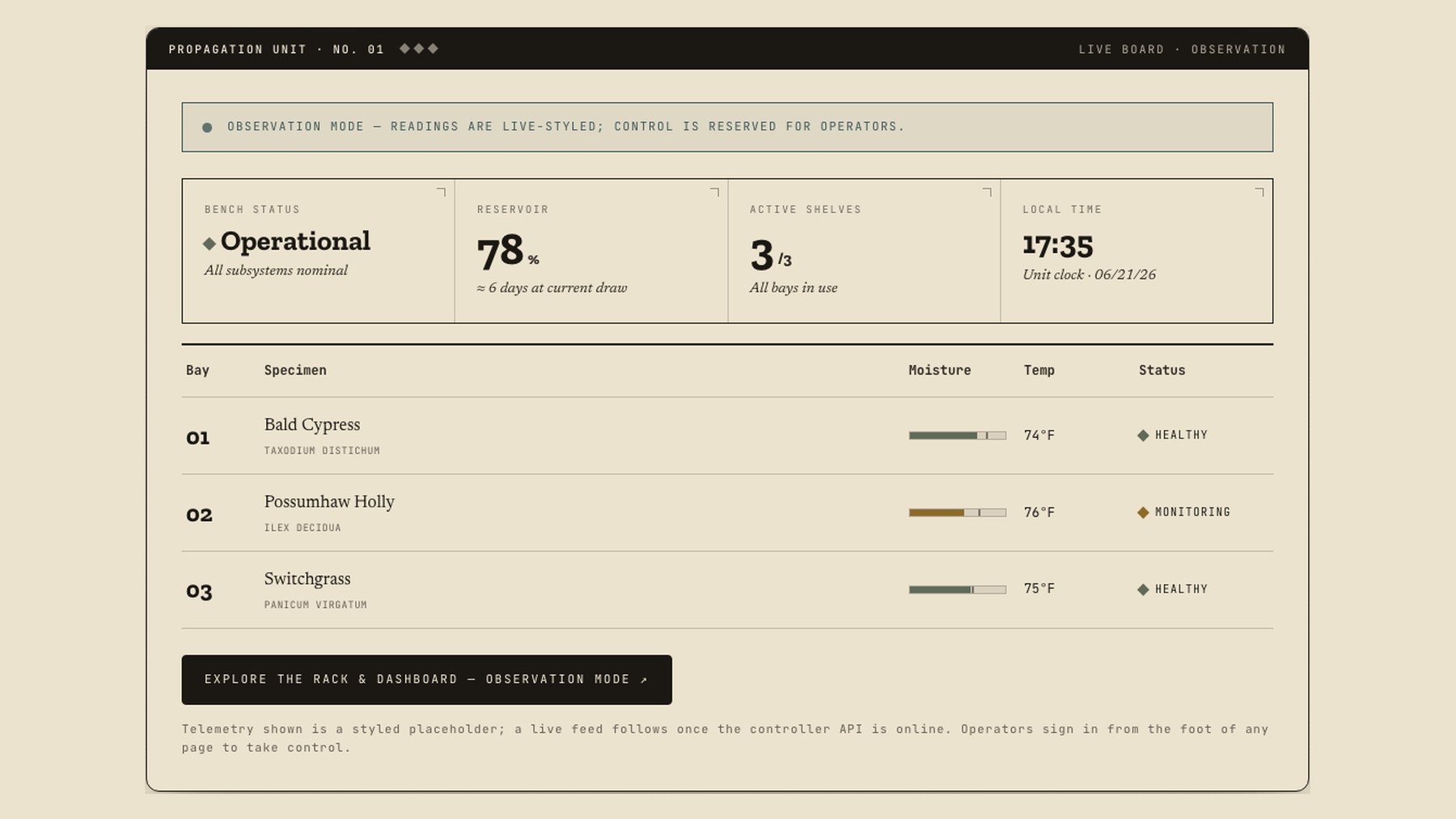 Fig · The unit’s live board, observation mode · telemetry is a styled placeholder until the controller API is online
The first Propagation Unit is a three-shelf bench that raises native restoration stock from seed and cutting with as little daily babysitting as the work allows. It's deliberately small — one rack, off-the-shelf parts, and a controller anyone could rebuild in a weekend. The point was never to build something clever. It was to see how much of a nursery routine you can hand off to a cheap sensor and a valve, so the crew can spend its hours out in the sections instead of standing at a hose.
What it must do
Hold each shelf inside a target moisture band. Run the lights on a per-shelf photoperiod. Move air with a fan. Water a shelf only when it drops below its floor, and never more often than its cooldown allows. And log every reading and every cycle, so a season can be reviewed instead of just remembered.
- Rack — three growing shelves, 01 through 03, on a steel wire frame
- Controller — a single-board Piconium reading moisture, temperature and reservoir level
- Water — 120 L reservoir, diaphragm pump, one solenoid valve per shelf
- Light — full-spectrum bars on a per-shelf schedule
- Air — USB circulation fans on the rack
- Interface — a 5″ Waveshare touchscreen at the rack and a web dashboard
Bill of materials
The full parts list, with the engineering notes, lives in the repo at docs/HARDWARE.md. The short version:
- Compute — a Piconium single-board computer (x86, 4 GB RAM) running Debian
- Display — Waveshare 5″ 800×480 touchscreen (HDMI + USB touch)
- Relays — Numato 8-channel USB relay module
- Serial — an FTDI RS485 adapter (FT232RQ + SP485EN)
- Grow lights — Barina full-spectrum bars, 120 VAC
- Fans — 12 V USB circulation fans
- Pump — a SEAFLO 12 VDC diaphragm pump
- Valves — four U.S. Solid 12 VDC solenoid valves, normally closed (they fail shut on power loss)
- Soil probes — RS485 multi-parameter soil probes (moisture, temperature)
- Reservoir sensor — a submersible hydrostatic level transmitter (RS485)
- Reservoir — a 120 L tank
- Rack — a three-shelf steel wire frame
The interface is public. You can open the same rack screen and dashboard the crew uses over on Instruments & Infrastructure — in observation mode, so you can click through every screen without touching the live bench.
The code is open source too — the full build, controller and dashboard live at github.com/Short-s-Resort-Field-Station/propagation-controller.