Why We’re Doing This — and What the Land Needs
A plain accounting of the ground we were handed, what's wrong with it, how we plan to fix it, and the trouble we expect on the way.
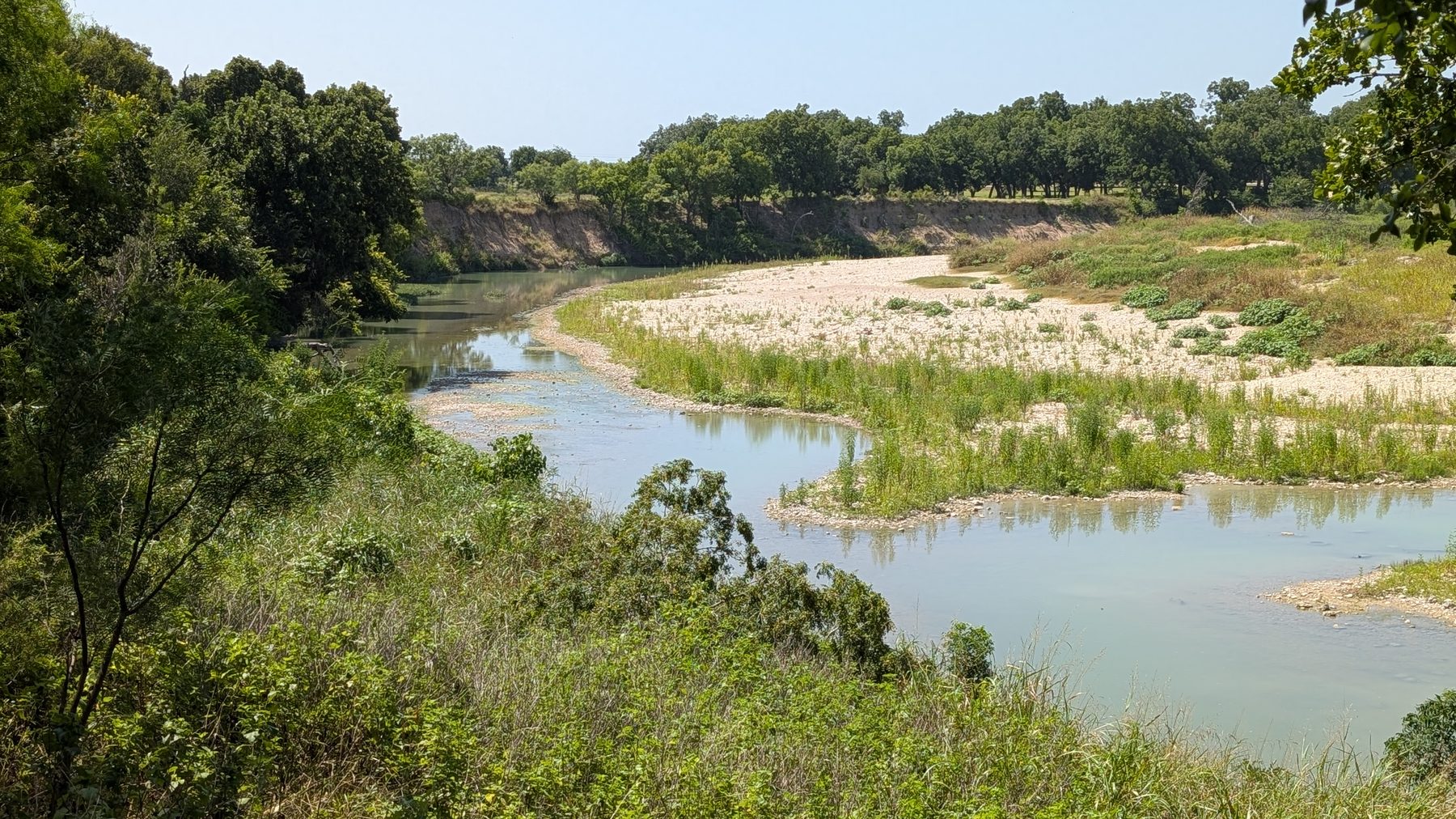 Fig · The Lampasas below the tract · July 2026
Any honest restoration starts by looking hard at what you actually have. What we've got is a tired piece of Central Texas: a hay meadow that's been run as improved pasture for decades, river frontage thinned out by grazing, and uplands where a few tough introduced grasses have crowded out almost everything else. It's not ruined. But it's a long way from what this ground could be, and closing that gap is the whole project.
The land's been in the family four generations — cleared off cedar and farmed for seed wheat in the '40s, grazed for decades, then held in Tifton 85 hay for the last twenty years. Each of those was the job the land got asked to do at the time. That's what we inherited. Here's what it needs now.
The core problem: a monoculture that works too well
Most of the working acres are Tifton 85 bermudagrass, with King Ranch bluestem and Johnsongrass filling in the edges. They're excellent forage and stubbornly good at their job, and that's exactly the problem. They form dense, single-species mats that shade out native seedlings, give almost nothing to grassland birds or pollinators, and leave the soil biology a lot simpler than a native prairie's. A field of Tifton 85 is green, productive, and nearly silent.
The fixes, in order
Restoration here is a sequence, not one move. First, convert the exotic pasture back to native prairie under the Texas Parks & Wildlife Pastures for Upland Birds program — knock down the introduced grasses, then no-till drill a native grass-and-forb mix built for this ecoregion. Second, pull the river frontage out of production as a conservation strip and let a riparian buffer come back. Third, build the woody structure back — a shelterbelt on the high ground and scattered mottes — grown out on our own propagation bench so the stock is local and cheap. Each fix has its own section on the tract and its own care class.
The problems we already see coming
We'd rather name the risks than pretend they aren't there. Reinvasion is the first — bermudagrass and Johnsongrass don't quit after a single pass, and the first two or three years are going to be a spot-treatment fight. Establishment is the second: native seed is slow, and a dry fall after drilling can cost us a whole planting. Water's the third — new plantings need it before their roots go deep, which is why a watering trailer is on the build list. And the last one is just time and continuity. This isn't a project that pays off in a growing season.
The honest horizon
The seed we drill won't look like prairie for years. Realistically the mix needs five to ten years to knit into something that carries itself, and the opening arc of the whole thing — conversion, riparian buffer, shelterbelt, first woody plantings — is a fifteen-year job. After that it's not "done," just handed forward: grassland is a disturbance ecosystem, and it wants fire and grazing and attention for as long as anyone keeps it. We're planting things we won't see finished. We're fine with that.